


FireSentinel
Equipping firefighters with autonomous robot dogs that go where humans can’t.
ROLE
Product Designer
TIMELINE
12 Weeks
Spring 2025
TEAM
4 Product Strategists
TOOLS/SKILLS
Figma
GTM Strategy
01
Summary
Erratic weather and limited manpower puts people at unacceptable risk.
As the effects of climate change increasingly become tangible, our capacity to fight against them remains limited. In early 2025, a series of fires in the Los Angeles area killed over 30 people and caused nearly $50B in property losses.
While preventative measures were limited by the weather’s volatility, a deeper systemic issue is also at hand—the decreasing bandwidth of firefighting power. The Los Angeles Fire Department (LAFD) operates with less than 1 firefighter per 1,000 residents, a ratio lower than most major U.S. cities. With worsening climate conditions and stretched-thin firefighters, both civilians and first responders are put at unacceptable risk.

For ACAD 181: Disruptive Innovation, a course at USC’s Iovine and Young Academy, I worked with three others to create FireSentinel: a deployable, autonomous robotics system designed to support wildfire response through live telemetry, suppression capabilities, and safer situational access. Though our work was grounded in business strategy and venture thinking, I led key efforts on operational system design, translating abstract risk into tangible, field-ready interfaces and user flows.
02
Problem Space
Wildfire response systems are grimly under-equipped.
First responders often enter unfamiliar terrain with limited knowledge, including a lack of visibility and aerial support. This was one of the main deadly factors of the wildfires that ravaged LA. These unpredictable weather behaviors also caused the fires to spread unpredictably, sending burning embers across the county and sparking new fires.
The world, including California, is increasingly prone to wildfires due to climate change, with arid conditions increasing LA’s wildfire likelihood by 35%. In fact, in LA, each firefighter is responsible for protecting over 1,140 residents — nearly 30% more than their counterpart cities such as San Francisco.
HMW empower first responders with autonomous tools that extend their reach, enhance safety, and provide real-time data in the most dangerous zones?
03
Solution
Wildfire response systems are grimly under-equipped.

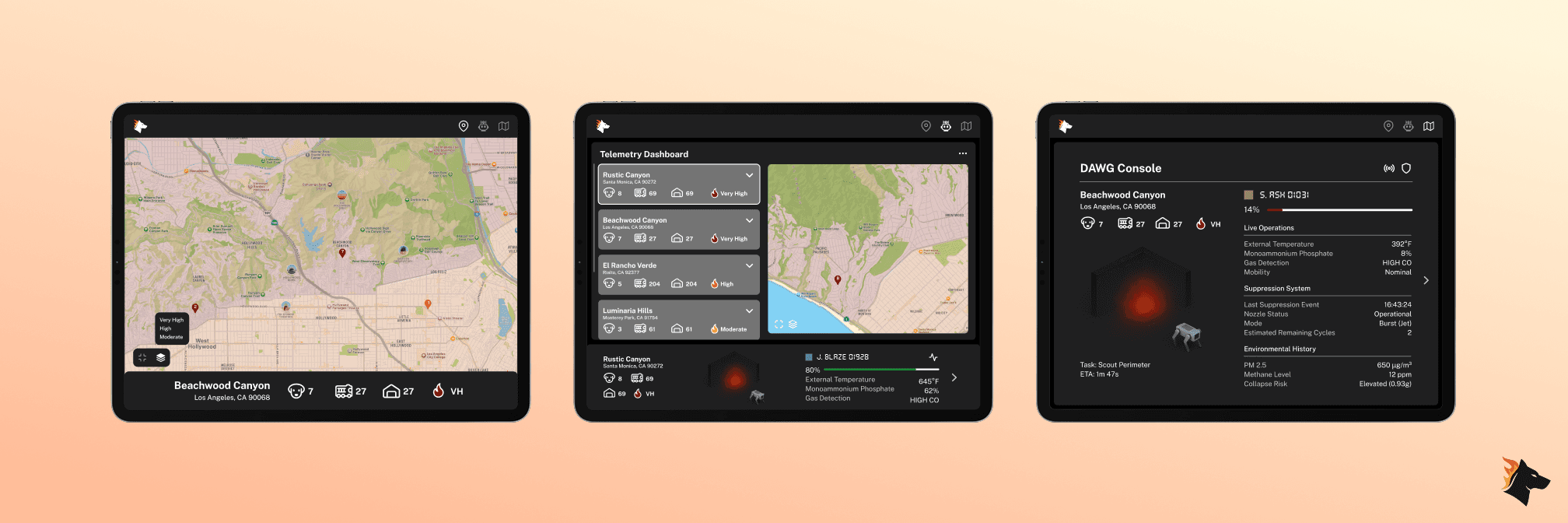
An overview of all active and deployed FireSentinel DAWG units in each neighborhood/region.
Highlighting the number of units
A color coded map corresponding to the Fire Hazard Safety Zones from the Office of the State Fire Marshal and the National Interagency Fire Center.
.
04
Problem Validation
We conducted a user interview with Santa Cruz firefighter Brian Sheckler, as well as studied the likelihood Firesentinel would receive Seed/Series A funding. We understood pain points and studied the growing market of global fire safety equipment to position the need for FireSentinel.
1
There has been a surge in AI and robotics investing.
Within 2024, global VC funding for AI startups reached $131.5B, a 52% increase from the previous year, with AI deals comprising over 60% of total VC investments in Q4. Resources such as FEMA's Assistance to Firefighters Grant Program also signal government support.
2
There is a labor shortage in emergency services.
Again, LAFD’s 3,500 firefighters are responsible for nearly 4 million residents, a ratio that challenges the department’s ability to respond effectively to emergencies, according to CNN. By contrast, San Francisco employs more than 1,800 firefighters for a population of 1.5 million.
3
There is a growing market sector on emergency response and disaster management.
Over 930 startups and 26,200 companies operate in the field, with the market projecting to reach $177.7B by 2025. In fact, fire stations are generally welcoming to new technology, so long as they pass rigorous on-site testing.
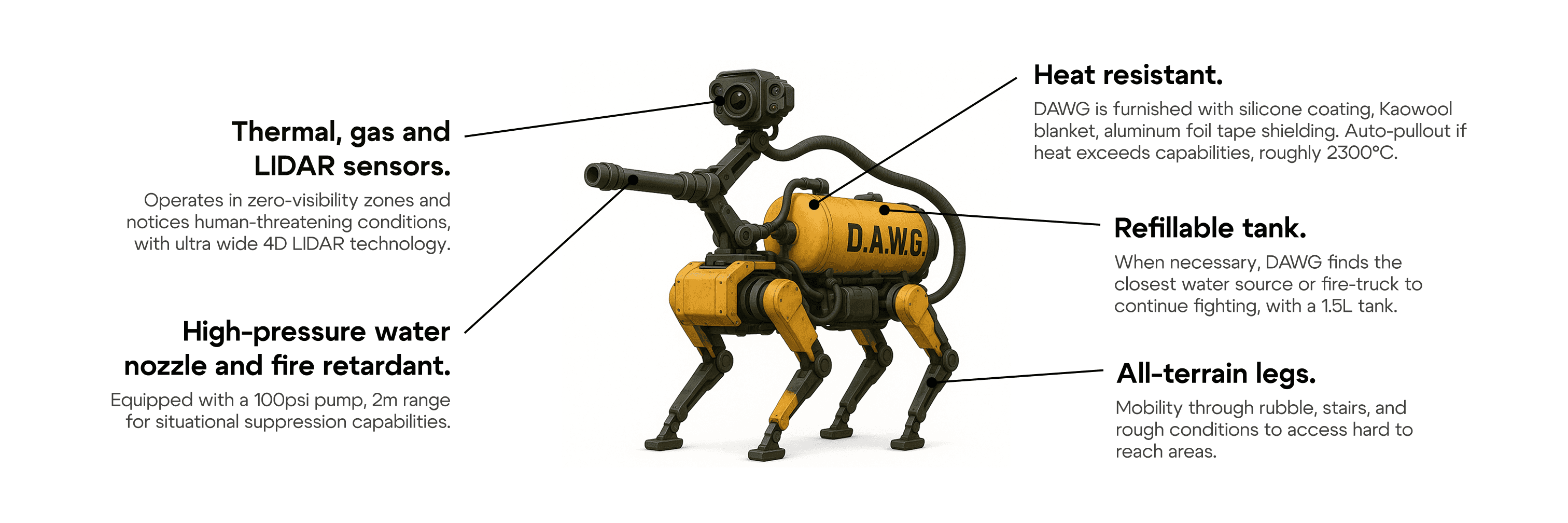
Highlighting these needs, my team and I based our product on three core features:
05
Design Process
I took lead on an interface that prioritizes our key features.
[ 1 ] INTERFACES
For a page that needed to condense a lot of information, I wireframed the DAWG Console page to emphasize the most important information.
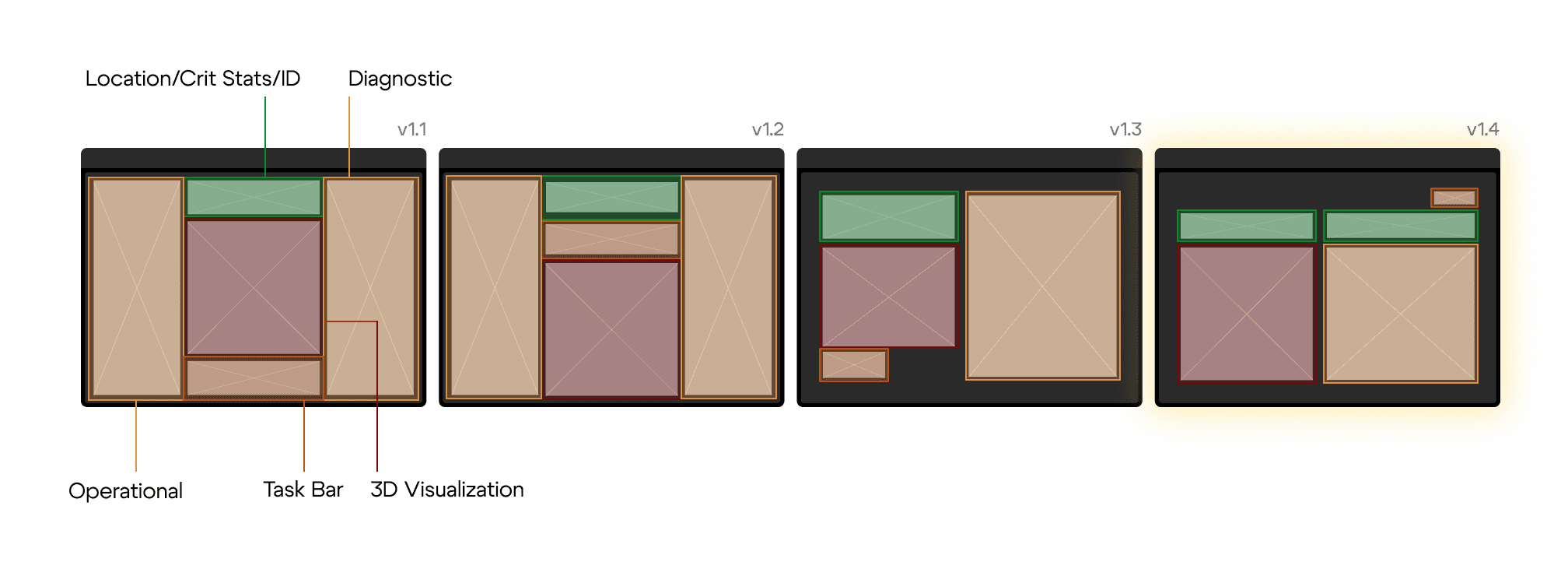
Condensing all the live operation and system diagnostics was challenging, especially when accommodating future iterations with potentially more metrics. I tinkered the most with hierarchy and information grouping.


For the Telemetry Dashboard, I also iterated the most on hierarchy and information grouping. This was also the first time I designed my own icons to easily represent the most critical information at-a-glance for firefighters.
And with the creative freedom I had in designing, I had the chance to focus on the details — playing with icon states and interactive elements for clear status communication for the Map feature.

[ 2 ] DESIGN SYSTEM
To create consistent and scalable branding, I combined all elements into a balanced design system. This also allows FireSentinel to accelerate its development process, focusing its R&D more on the hardware.

To make our dreams reality, we had to ground our goals.
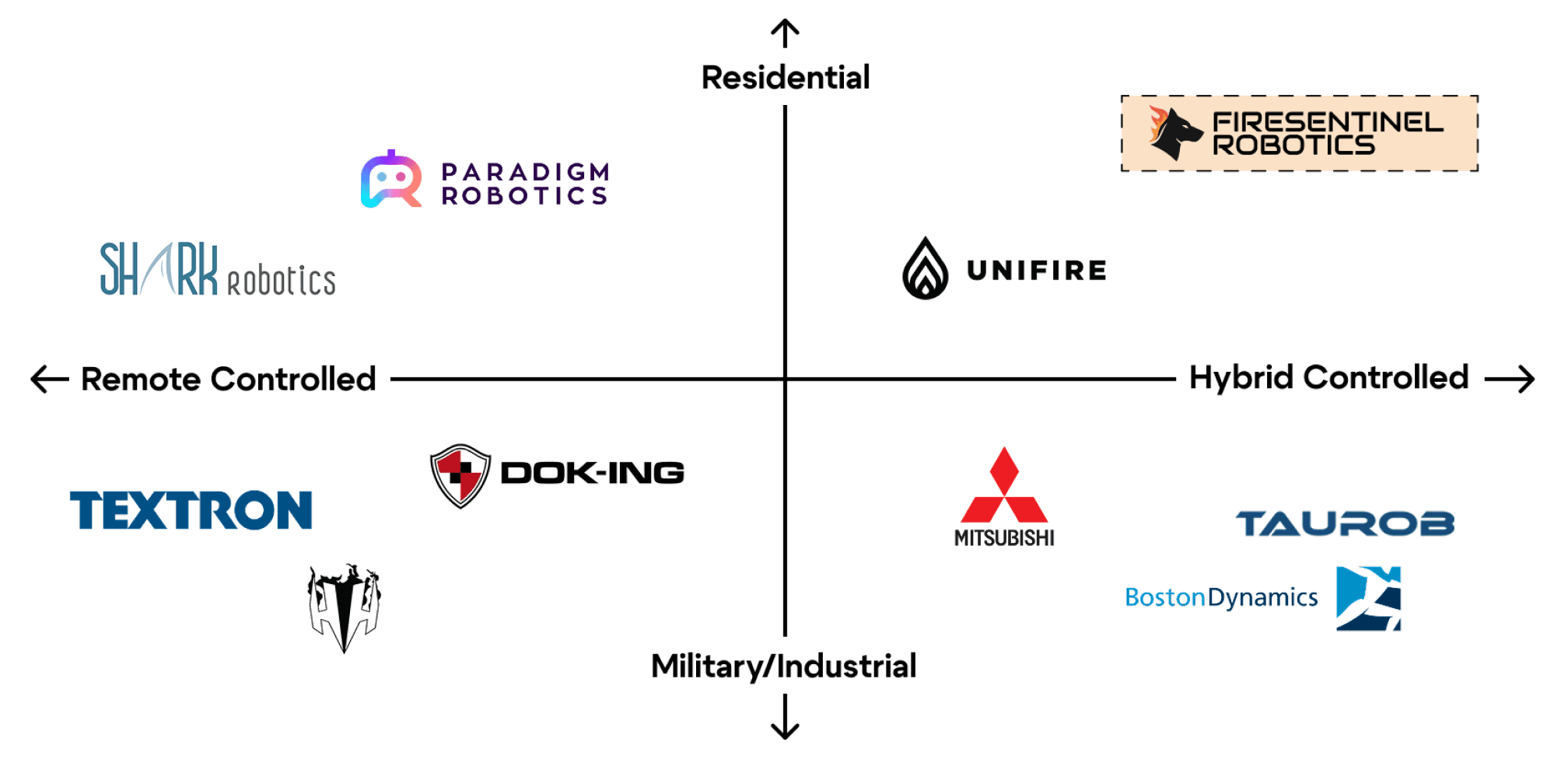
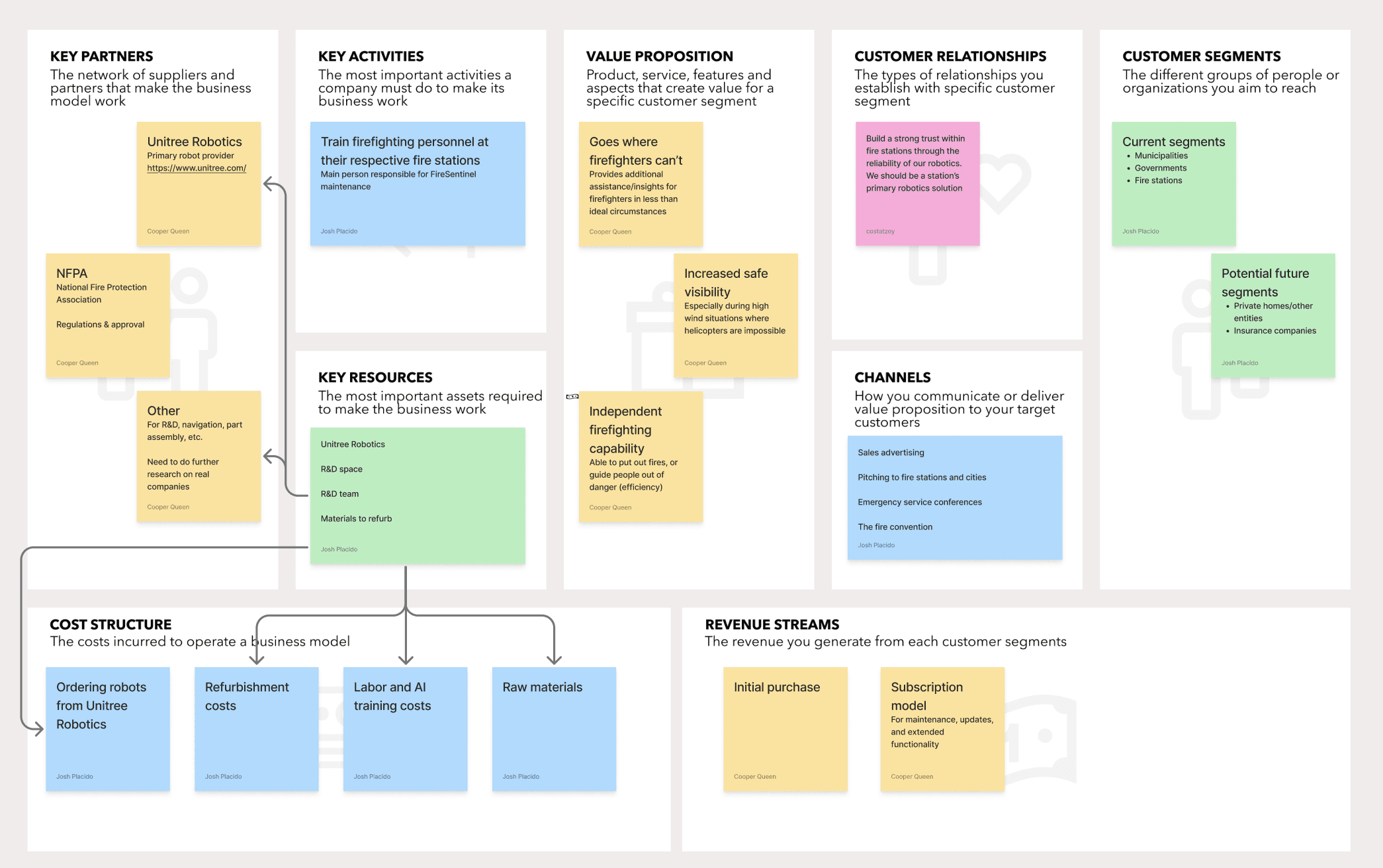
[ 1 ] COMPETITOR ANALYSIS
Within already existing companies that specialize or include firefighting robotics systems, FireSentinel reigns on top—especially within its hybrid capabilities and residential targets.

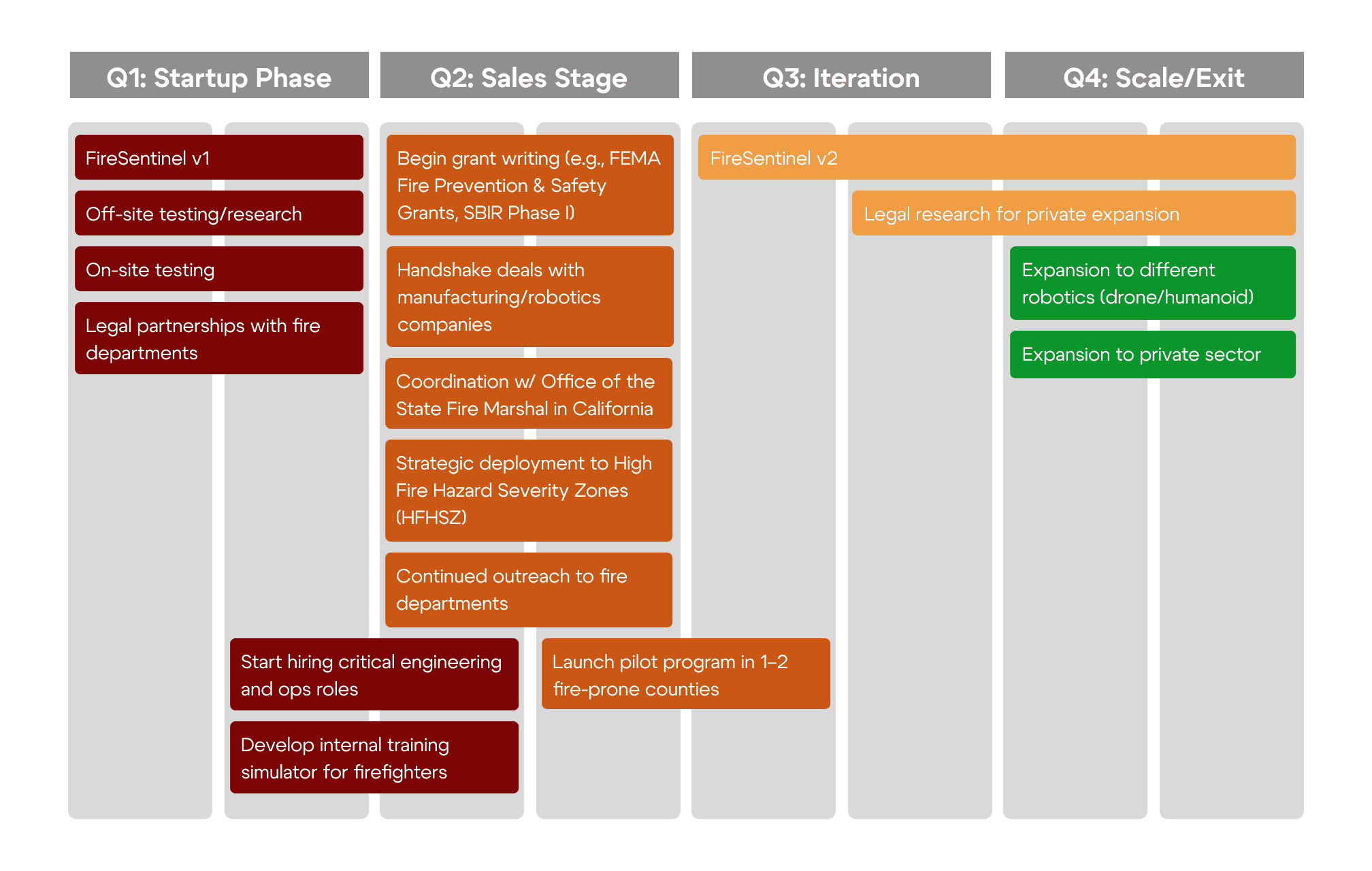
[ 2 ] PRPODUCT ROLLOUT
To synthesize the business skills we had learned in class, we also emphasized the feasibility of our product given Series A funding. With certain KPIs, such as legal certification and DAWG R&D on-field iteration, we fully laid out the implementation of FireSentinel for a fiscal year.
From these analyses, FireSentinel is built on three main ideas:
07
Takeaways
Design is a holistic process.
Being involved in the business- and capital-aspect of our product allowed me to be a more informed and intentional designer. With this class taking on a more product management angle, I was forced to lean outside of my newfound niche of UI/UX. Being receptive to all aspects of a product is important to designing a more intuitive product that fits your user better.
Visual storytelling is critical in new ventures.
Out of all crit sessions, we mainly iterated the most on our user scenario of our pitch deck. My team and I held countless calls and meetings to extract the key message of our product, in a way that made the most sense to our target audience, from more pathos to logos.
User interviews are the clearest way to define pain points.
If more time allowed for the scope of this product’s development, we would have greatly benefited from interviewing more firefighters, especially across the LA county. While this product is designed to be scaled, the bandwidth gap among LA firefighters is among the most critical. Understanding specific pain points more closely would allow our product to integrate more seamlessly with already existing workflows.
And a special shoutout to my team members Cooper, Costa and Siena — and Chris Swain for his professional mentorship throughout this process!